
How Telecom Operators Use LiDAR for Pole and Conductor Inspection
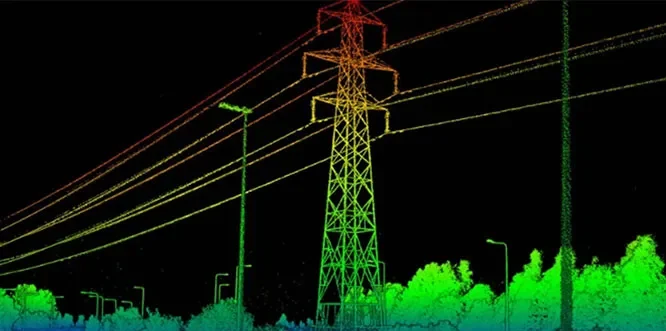
Pole and conductor inspection has historically been a manual, climb-or-measure-by-hand process — slow, and not without real safety risk for the crews doing it. As telecom networks expand and infrastructure ages, the volume of poles and conductors needing regular inspection keeps growing, while the manual process used to inspect them hasn't gotten any faster.
What Manual Inspection Misses
Beyond the labor cost, manual inspection has a consistency problem. Measurements taken by different crews, on different days, with different tools, don't always produce comparable results. A conductor sag measurement that should trigger a maintenance flag might get judged differently depending on who's measuring and how. And because manual inspections happen periodically rather than continuously, problems that develop between inspection cycles can go unnoticed until they cause a failure.
How LiDAR-Based Inspection Works
A LiDAR survey captures the pole, conductors, and surrounding environment as precise 3D geometry, paired with high-resolution panoramic imagery overlaid onto that geometry. From this single capture, AI-based asset detection identifies individual poles and conductors, while the underlying point cloud provides exact measurements — conductor height, sag, clearance from other structures or vegetation — without anyone needing to physically measure anything in the field.
Because the measurement comes directly from precise 3D data rather than a person's visual estimate or tape measure, results are consistent regardless of who processes the data or when.
A Typical Workflow
A mobile LiDAR pass captures a corridor of poles and conductors in a single drive-through. AI-based classification flags each pole and conductor automatically, measuring clearance and sag against compliance thresholds. Any flagged issues — insufficient clearance, conductor sag exceeding a safe range, vegetation encroachment near a line — get surfaced for review, with the overlaid imagery letting a reviewer visually confirm the issue before it's escalated. The result is a compliance-ready dataset covering an entire corridor, generated from one pass rather than a sequence of manual site visits.
Why This Matters for Telecom Operators
Compliance and safety obligations don't go away as networks scale — if anything, they get harder to manage manually as the number of poles and conductors grows. LiDAR-based inspection doesn't just speed up the process; it makes the underlying measurements more consistent and the resulting compliance record easier to defend, since it's backed by precise data rather than field notes.
Request Call Back
Related Blogs

Inside Truly3D LiDAR Viewer: Mobile Mapping to Insights
Inside Truly3D — From Mobile Mapping Capture to Usable Insight
Read More
Mobile Mapping vs. Handheld LiDAR — Which One Fits Your Survey?
In today's fast-paced infrastructure and geospatial industry, accuracy and efficiency...
Read More